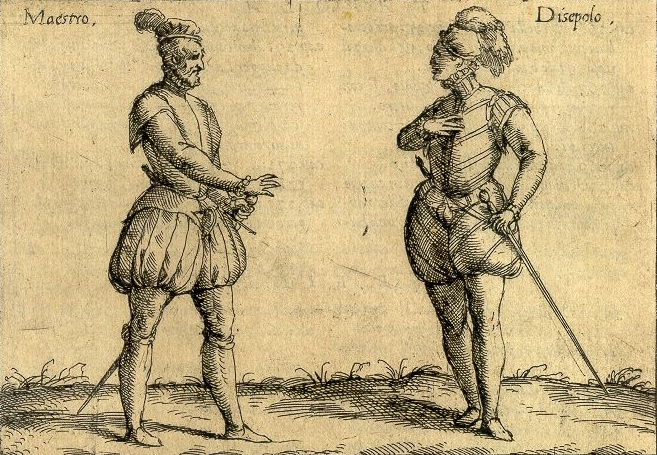
What does it mean when someone says they practice Bolognese fencing?
Everyone has a different answer but for me it means that I practice fencing with 16th century weapons using the advice and instructions from a collection of internally consistent treatises loosely associated with the city of Bologna. The system described in those treatises was one of the last truly universal systems of fencing, being equally suited to street self defence and military skirmish as it was to one on one duels and fencing in the salle for fun or display. The weapons whose use is described in the Bolognese tradition are: single sword, sword & buckler (of various shapes and sizes), sword & dagger, two handed sword, two swords, various polearms, sword & rotella (a round shield), sword & cloak, dagger, dagger & cloak, and more. It is as close to a “complete” renaissance system of combat as it is possible to find. A full listing showing all the weapons and which treatises discuss them is included in the table at the bottom of the page. In this series of posts I will be discussing the treatises in the tradition, how to choose a text to study, why the core weapons are the sword & buckler and the sword alone, what equipment is required, and some principles for training safely.
What are the Bolognese source texts?
There are five texts that I consider members of the Bolognese corpus, and we typically refer to these by author names. There are a variety of factors linking these texts: they were all published within a roughly 50 year window; written by Bolognese citizens; published or written close to Bologna whether that be in just in northern Italy or more specifically in Bologna itself; the theory and language they use to describe fencing is extremely consistent; the way that information is presented and discussed is very similar; and there are many very similar sequences of techniques presented amongst them.
The earliest published treatise Opera Nova by Antonio Manciolino which was completed in 1522-231 and the edition available to us moderns was published in 1531. The second text to be published (in 1536) was Achille Marozzo’s work also called Opera Nova, this proved hugely influential and the 1536 edition was followed by reprints in 1546, 1567, and a second edition in 1568 and a further reprint in 16152. Of all the texts in the tradition these two are the most similar to each other, presenting the weapons covered in the same order and including long forms to be practised solo or with a partner. These forms are called assalti (assalto in the singular – assaults in English) and there are very strong similarities between the assalti of these two authors especially for the sword and small buckler. Both authors teach 2 assalti for sword & small buckler followed by plays for the strette di meza spada (grappling, striking, disarms, and close quarter combat type techniques3); then assalti or plays for sword and various companions (big buckler, dagger, another sword, rotella, and cloak), then various polearms.
Marozzo’s work is distinctive because of its length and comprehensiveness, including substantial material on every weapon in the Bolognese corpus and some of which is not found in any other Bolognese work i.e. a massive two handed sword section and a section on self defence against daggers. Manciolino’s text is much more concise and better written, making it significantly more straightforward to translate. If your interest in Bolognese fencing is primarily driven by interest in medieval methods these two are the most relevant to that.
Our third text is also a good resource for older, more medieval methods. It is a compilation of two closely related manuscripts, probably separate drafts of one intended text (both sadly missing substantial sections4) without an attributed author, which were found and published together as the Anonimo Bolognese in 2005. These could be dated anywhere from 1500-1550: the paper used suggests pre 15205, some aspects of the language suggest later6, some people think earlier on the basis that it includes combat with poleaxe in armour7, others believe that the preponderance of plays for the singlesword as well as the emphasis on fencing using thrusts and disengages indicates later8. The system of guards used in the Anonimo is defined by the position of the sword and sword hand, mostly, independently of which foot is forward. This is attractive for theoretical consistency but less practical when fencing because it requires more words to convey the same information. To compare the guards from most of the bolognese texts you can use Ilkka Hartikainens guard inspector which displays the various guards filtered by author, feet, or guard type.
Fourth, is Angelo Viggiani’s Lo Schermo which was completed in 15519 but not published until 1575, 15 years after his death. Written as a dialogue, the work is highly theoretical for it’s time and includes many crucial details omitted by other authors – for a long time the historical fencing community has used theory from Viggiani to flesh out the practice of other Italian systems like Fiore, or Vadi. Few people however choose to practice Viggiani as their main focus because of the relative scarcity of actual fencing plays within it. The book is unusual for the Bolognese because it derides the guard names used by other Bolognese authors and uses its own system of names to signify essentially identical positions – these names communicate important ideas about how to use the guards that can be applied no matter what text you follow. This work is entirely focused on the single sword.
The last of the Bolognese texts is Giovanni dall’Agocchie’s Dell’Arte di Scrima Libri Tre, published in 1572, and also written as a dialogue, this text is much more modern in style while still retaining the key features of the Bolognese pedagogy, including guard names and short sequences to be practiced solo or as a pair, much like the assalti of Marozzo or Manciolino. His text is very valuable because the fencing it describes is reasonably conservative in the sense that he isn’t trying to create something new, like many other authors of his time, but rather his intention is to explain existing fencing practices in a more systematic and concise way than earlier authors. The text is well organised with more modern pedagogy. It begins with a short list of six fencing headings arranged from most fundamental to most advanced in the following order: the parts of the sword, the blows, the guards, how to move in the guards, how to defend and attack from the key guards, and finally timing and the strette di meza spada. If your interest is in the single sword this the text to start with as all of the fundamental material is taught with the sword alone, only later does the text move on to the sword & dagger, the sword & cape, then jousting and battle tactics.
There are plenty of other treatises on fencing written by people from Bologna, or written at the same time and discussing similar weapons and concepts. However none of these texts have the crucial unity of theory, guard positions and weapons in these five, even with all of their distinct peculiarities.
*Manciolino teaches an assalto to be done with big buckler or targa
End notes
1. Leoni, Tom. The Complete Renaissance Swordsman: Antonio Manciolino’s Opera Nova (1531). Freelance Academy Press, 2010, 11
2. “Opera Nova (Achille Marozzo).” Wiktenauer. Accessed August 27, 2020. https://wiktenauer.com/wiki/Opera_Nova_(Achille_Marozzo).
3. Look out for a more complete definition in future posts – you could write an essay just defining this phrase.
4. Anonimo Bolognese (Ravenna, Classense Library, MS 345 and MS 346). Edited by Marco Rubboli and Luca Cesari, L’Arte della Spada. – Trattato di scherma dell’inizio del XVI secolo (Rimini: Il Cerchio, 2005), 13
5. Ibid, 13
6. Mele, Greg. (2017, June 4) “…Use of the J and some some other “Lombardisms” that appear in the second quarter of the 16th century,” [Facebook comment] Retrieved from https://www.facebook.com/groups/dallagocchie/?post_id=1403274536405221
7. “Anonimo Bolognese (MSS Ravenna M-345/M-346).” Wiktenauer. Accessed August 27, 2020. https://www.wiktenauer.com/wiki/Anonimo_Bolognese_(MSS_Ravenna_M-345/M-346).
8. Fratus, Stephen. (2017, June 4) ¨…much of the single sword fighting is a lot like later rapier fighting.” [Facebook comment] Retrieved from https://www.facebook.com/groups/dallagocchie/?post_id=1403274536405221
9. “Angelo Viggiani Dal Montone” Wiktenauer. Accessed August 27, 2020. https://www.wiktenauer.com/wiki/Angelo_Viggiani_dal_Montone.
Primary Sources
dall’Agocchie, Giovanni. Dell’Arte di Scrima Libri Tre. Venice: G. Tamborino, 1572
Anonimo Bolognese (Ravenna, Classense Library, MS 345 and MS 346). Edited by Marco Rubboli and Luca Cesari, L’Arte della Spada. – Trattato di scherma dell’inizio del XVI secolo (Rimini: Il Cerchio, 2005).
Manciolino, Antonio. Opera Nova per Imparare a Combattere, & Schermire d’ogni forte Armi. Venezia: N. d’Aristotile detto Zoppino, 1531.
Marozzo, Achille. Opera Nova de Achille Marozzo, Mastro Generali de l’Arte de l’Armi. Modena: D. Antonio Bergolae, 1536.
Viggiani, Angelo. Lo Schermo. Venice: Giorgio Angelieri, 1575
I like the way this is laid out explaining the time period and your chart of which weapon combinations are found in each of your five main texts is really a nice visual. It helps direct me on where to look if I’m interested in one particular thing or a comparison of the same weapon combination across Bolognese masters.
Thanks, I’m glad it’s useful 🙂