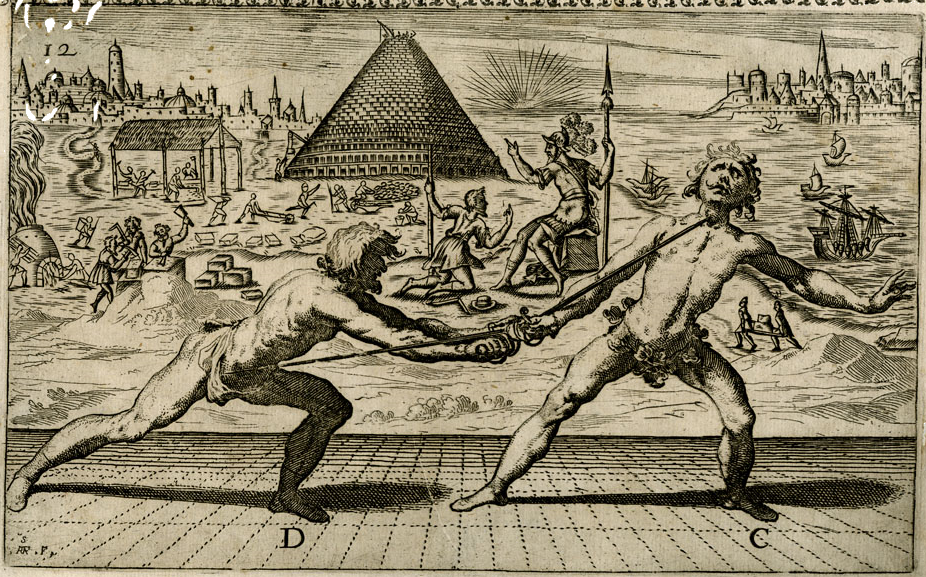
It is very important to use and understand the fencing concepts of tempo.
Tempo can be quite confusing and rather than explaining it in my words I have translated some of the writings on tempo by both Ridolfo Capoferro (published 1610) and Giovanni dall’Aggochie (circa 1570) below. There are some clear differences and areas where Capoferro and dall’Agocchie disagree due to the changes that occurred in fencing during the 40 years between the two texts.
I hope you find it useful.
Capoferro says:
“TEMPO
Four kinds of tempo are designated in the school, the primo (first) tempo, the dui (two) tempi, the mezzo (half) tempo & the contra (counter) tempo; the primo tempo would be when finding myself in the misura stretta (narrow measure) or larga (wide measure) I can strike the opponent with only one movement of the sword, from which likewise it is known that the strike of dui tempi requires at least two movements of the sword; mezzo tempo is when in the misura larga, I strike the opponent in the advanced and uncovered arm, with the dagger or with the sword, thrust or cut, or when I strike the opponent in the misura stretta, while they move to attack me or to make some other action; the redoublemont of blows is done in contra tempo more than in the mezzo tempo; contra tempo is when in the same tempo the opponent wants to wound me I strike them in a shorter tempo and measure; & you should know that all the movements and all the pauses of the opponent, while in measure, are tempi.
IN HOW MANY TEMPI ONE CAN STRIKE
The first tempo is when the opponent is fixed in guard & they lift or move the front foot to approach you, that is a tempo; the second is when you have parried the blow, at that moment there is a tempo; the third, as they move without judgment from one guard to go into another guard, before they are fixed in [guard] it is a tempo to strike them; & another tempo is when they lift the sword, while they raise the hand, that is a tempo to strike them; and the last is when the blow has passed outside your body, that is a tempo to chase after them with the riposte. “
dall’Agocchie says:
“Lep. First I would like you to clarify a doubt for me, which is this: you have said that every blow can be parried, how therefore does one strike the opponent?
Gio. With the tempo: because every time that you strike in tempo, you will be safe & on the contrary, when you attack out of tempo, you can be struck.
Lep. Explain this to me better. The tempo to strike is recognised in five ways.
Gio. Since you have given me the opportunity to discuss tempo, I will tell you. There are five ways to recognise the tempo to strike.
The first is when you have parried the opponent’s blow, at that moment is a tempo to strike.
The second, when the blow has passed outside your body, that is a tempo to follow it with the most convenient riposte.
The third, when they lift the sword to attack you, while they lift the hand, that is a tempo to strike.
The fourth, as they move without judgement from one guard to go into another, before they are fixed in it, that moment is a tempo to strike them.
The fifth & last, when the opponent is fixed in guard, & they lift or move the forward foot to adjust their stance or to approach you, while they are lifting the foot, that is a tempo to strike them: because they cannot attack you being discomposed.
Lep. And when they move the rear foot?
Gio. It is another tempo: but not as much as it is moving the forward foot
Lep. Since you have specified the ways in which one can recognise the tempo to strike. I would like you to tell me more about how many tempi one can use to strike with the sword?
Gio. Two tempi, one tempo, and half tempo. The two tempi are these, when the sword parries, and then strikes.
One tempo is when one strikes without parrying the blow, or when one parries & strikes in one instant.
The half tempo, & last, is when one wounds while the opponent throws a blow. But to return to the discussion of attacking out of tempo, I say that with those that deliberately go to attack without any advantage, their opponent being fixed in guard, go out of tempo: because in this case they will be found open or their opponent will be able to make the counters that I have specified in the fifth heading [i.e. the parries].
Lep. Now that I understand all the ways to recognise the tempo to attack, I would also like to know how to, move my feet, or change my guard with judgement & without danger, as I will need to do.
Gio. When you recognise that in moving your feet, or changing your guard, the opponent could push a thrust at you, you can move yourself backwards, or spin around, turning a tramazzone at them in that tempo against their sword.
You could also move the foot backwards, or as you move, hit your opponent’s sword with either the false or true edge, throwing a cut or a thrust at them according to the circumstance. Because by doing this, you will be able to move yourself with judgement & without danger.”
Please note that that these translations are my own professional work, and that while I have put them here for anyone to use for their own training and study, you must contact me to request permission to use it in any publication or for any commercial use.
Transcription of the original Italian text of Capoferro courtesy of Società d’Arme dell’Aquila hosted on Wiktenauer.
“DEL TEMPO
3 Quattro sorti di tempi si sentono nominare nelle scuole, il primo, i dui tempi, il mezzo & il contra tempo; il primo tempo vogliano che sia quando, trovandomi a misura o stretta o larga io posso ferire l’avversario con un sol movimento di spada, onde parimenti si conosce che il ferire di due tempi richiede almeno due movimenti di spada; mezzo tempo è quando a misura larga ferisco l’avversario nel braccio avanzato e scoperto, sia quello del pugnale o quello della spada, di punta o di taglio o vero quando ferisco l’avversario a misura stretta, muovendosi egli a ferirmi o a fare qualche altro atto; il radoppiare delle botte si fa più che in mezzo tempo, contra tempo: è quando nel medesimo tempo l’avversario mi vuol ferire io l’incontro in più breve tempo e misura; & si vuol sapere che tutti i movimenti e tutti i riposi dell’avversario sieno tempi, però a misura.
IN QUANTI TEMPI SI CONOSCE IL FERIRE
5 Il primo è quando il nimico è fermo in guardia & che egli alzasse o movesse il piede che haverà innanzi per accostarsi, quello è tempo; l’altro quando harai parato il colpo, all’hora è tempo; il terzo come egli si movesse senza giuditio di una guardia per andar in un’altra, innanzi che egli sia fermo in essa è tempo di offenderlo; & di più è tempo quando egli alzasse la spada mentre che egli alza la mano, quello è tempo di ferirlo; e l’ultimo è quello quando il colpo haverà trascorso fuori della persona, quello è tempo di seguirlo con la risposta.”
Transcription of the original Italian text of dall’Agocchie courtesy of Andrea Morassutto:
Lep. Voglio prima, che mi dichiariate un dubbio: il qual è questo. Voi havete detto, che ogni colpo si può parare: come dunque si hà da ferire il nimico?
Gio. Co’l tempo: perché ogni volta, che voi ferirete con tempo, sarete sicuro: & per il contrario, quando ferirete fuori di tempo, potreste essere offeso.
Lep. Dichiaratemelo meglio. Tempo da ferire si conosce in cinque modi.
Gio. Poi che mi date occasione di ragionare del tempo; vi dirò. Cinque modi sono da conoscere questo tempo da ferire.
Il primo è, quando haverete parato il colpo del nimico, che all’hora è tempo da ferire.
Il secondo, quando il colpo vi haverà trascorso fuori della persona, che quell’è tempo da seguirlo con la risposta più convenevole.
Il terzo, quando egli alzasse la spada per offendervi: mentre ch”egli alza la mano; quell’è il tempo di ferire.
Il quarto, come egli si movesse senza giudicio d’una guardia per andare in un’altra; avanti ch’egli sia fermo in essa, all’hora è tempo di offenderlo.
Il quinto & ultimo, quando il nimico è fermo in guardia, & ch’egli alzasse, ò movesse il piede, che haverà innanzi per mutarsi di passo, o per accostarsi; mentre ch’egli alzerà il piede, quello è tempo da ferirlo: perché egli non può offendervi per esser’discomodo.
Lep. Ma quando egli movesse quel dietro?
Gio. E tempo ancora: ma non tanto, come è movendo quel dinanzi
Lep. Dapoi che mi havete dichiarato i modi, per liquali si può conoscere il tempo da ferire; vorrei che mi diceste ancora di quanti tempi con la spada si può ferire?
Gio. Di due tempi, un tempo, et mezzo tempo. I due tempi sono quelli, quando la spada para, e poi ferisce.
Un tempo è quello, quando si ferisce senza parare il colpo, ò vero quando si para, & ferisce in un’istante.
Ilò mezzo & ultimo è quello, quando si ferisce, mentre che’l nimico tira il colpo. Ma èper far ritorno al ragionare del ferire fuori di tempo; dico. Colui che anderà deliberato senza alcun vantaggio per ferire, essendo il nimico fermo in guardia; anderà fuor di tempo: perché in quel caso lo troverà libero, ove h’egli potrà fare i suoi contrarij come vi dissi nella dichiaratione del quinto capo.
Lep. Hor ch’io hò inteso tutti i modi da conoscere il tempo da ferire, vorrei ancor sapere, quando io volessi movere i piedi, ò mutarmi di guardia con giudicio, & senza pericolo, come haverei da fare.
Gio. Quando voi conosceste, che nel movervi di passo, ò mutandovi di guardia: il nimico spingendo la spada vi potesse arrivare; voi vi potete movere all’indietro, ò girare intorno, volgendogli in quel tempo un tramazzone contra la sua spada.
Potete ancora mover il pie di dietro, ò vero nel movervi, urtare co’l falso, ò co’l fil dritto nella spada nimica, tirandogli di taglio, ò di punta, secondo l’occasione: perché ciò facendo, verrete a movervi con giudicio, & senza pericolo.
Leave a Reply